Table of Contents
ToggleTable saw kickback is one of the most dangerous events that can happen in a home workshop. In a fraction of a second, a piece of wood can transform into a projectile traveling at speeds exceeding 100 mph, capable of causing severe injury or worse. Understanding what causes kickback, recognizing the warning signs, and implementing proper safety techniques aren’t just best practices, they’re essential skills that separate confident woodworkers from those headed to the emergency room. Whether someone’s ripping plywood for cabinet boxes or crosscutting trim, knowing how to prevent and respond to kickback can literally save fingers, hands, and lives.
Key Takeaways
- Table saw kickback occurs when a spinning blade throws wood backward at speeds exceeding 100 mph, making it one of the most dangerous workshop hazards that can be prevented with proper technique and equipment.
- A properly installed riving knife is the single most critical safety device for preventing table saw kickback by keeping the kerf open and preventing wood from binding against the blade.
- Common kickback causes include misaligned fences, warped lumber, improper body positioning, and using the miter gauge with the fence simultaneously—all of which are preventable through pre-cut verification and material inspection.
- Recognizing warning signs like increasing blade resistance, burning wood, unusual noise, and that instinctive gut feeling allows operators to stop and reassess before a dangerous kickback event occurs.
- If kickback happens, never attempt to catch the workpiece; instead, immediately release the power switch, step to the side, and let the blade coast to a complete stop before investigating the cause.
What Is Table Saw Kickback and Why Does It Happen?
Kickback occurs when the workpiece is violently thrown back toward the operator by the spinning blade. The saw blade rotates toward the operator at the front of the table and away at the back. When wood gets pinched, bound, or misaligned with the blade at the rear of the cut, the rising teeth catch the material and launch it backward with tremendous force.
The physics are straightforward but brutal. A 10-inch blade spinning at 3,450 RPM has a rim speed of roughly 90 mph. When the rear teeth grab wood that’s binding against the blade, that rotational energy transfers instantly into linear momentum. The workpiece doesn’t just push back, it rockets.
Several mechanical factors contribute to kickback:
- Blade binding: When the kerf (the slot cut by the blade) closes behind the blade due to internal wood stress or improper support, the blade gets pinched. As the rear teeth rise through the wood, they lift and throw the piece.
- Misalignment: If the fence isn’t parallel to the blade or the miter gauge isn’t square, the workpiece can twist during the cut and contact the blade at an angle.
- Blade contact with offcuts: Small pieces or the waste side of a cut can rotate into the blade and get ejected.
- Dull or damaged blades: Blades with missing teeth, pitch buildup, or insufficient set create more friction and increase binding.
Kickback typically happens during rip cuts more than crosscuts, though both present risks. Ripping long boards or sheet goods magnifies the danger because there’s more material to bind and more mass to accelerate.
Common Causes of Table Saw Kickback
Most kickback incidents trace back to a handful of preventable mistakes. Recognizing these common errors helps DIYers avoid them.
Improper fence alignment is the leading cause. If the fence angles even slightly toward the blade (toe-in), the workpiece gets progressively pinched as it moves through the cut. The fence should be perfectly parallel to the blade or have a microscopic toe-out (away from the blade at the rear). Check alignment with a reliable straightedge or dial indicator.
Cutting warped, twisted, or wet lumber invites trouble. Internal stresses in wood cause the kerf to close unpredictably. Wet or green lumber is especially prone to binding as it flexes during cutting. Let lumber acclimate to shop conditions and inspect each piece before cutting.
Freehand ripping without a fence or guide is asking for kickback. The workpiece must be supported and guided consistently throughout the cut. Similarly, using the miter gauge and fence together on the same cut (unless one has a crosscut sled or specific jig) can trap wood between the two, causing binding.
Releasing the workpiece mid-cut or failing to use push sticks allows the wood to shift and contact the blade incorrectly. Maintain firm, consistent pressure through the entire pass. Once committed to a cut, follow through completely.
Standing directly behind the workpiece puts the operator in the path of kickback. Always position the body to either side of the cutting line. Experienced woodworkers stand slightly to the left (on most saws) and keep their head and torso out of the firing line.
Cutting small pieces without proper support or trying to rip narrow strips between the blade and fence increases the chance of the piece twisting or getting caught. For strips narrower than 3 inches, consider cutting the waste side and using push blocks or featherboards for control.
Warning Signs You’re About to Experience Kickback
Kickback rarely happens without some advance indication. Learning to recognize these warning signs gives operators a critical moment to stop the cut and reassess.
Increasing resistance or blade bog means something’s binding. If the motor starts to labor or the workpiece becomes harder to push, stop feeding immediately. Don’t force it. Turn off the saw and investigate the cause, the fence alignment, blade condition, or internal wood stress.
Burning or smoking wood indicates excessive friction from a dull blade, improper feed rate, or binding. Burn marks on the cut edge are a red flag. The same friction that creates heat also increases the likelihood of kickback.
Unusual blade noise or a change in pitch suggests the blade is contacting the wood at varying pressures. A smooth cut produces a consistent sound. Squealing, grinding, or stuttering means trouble.
The workpiece drifting away from the fence during a rip cut signals that the wood is twisting or the fence isn’t parallel. If maintaining contact with the fence requires angling the piece, stop the cut.
Visible movement or vibration in the workpiece when it’s supposed to be stable against the fence or miter gauge indicates insufficient control. Secure the piece properly or use additional support before proceeding.
Many woodworkers report a gut feeling, something just doesn’t feel right. Trust that instinct. It takes seconds to stop the saw, check the setup, and restart. It takes months to recover from a kickback injury.
Essential Safety Features and Equipment to Prevent Kickback
Modern table saws include several features specifically designed to reduce kickback risk. Understanding and using them properly is non-negotiable.
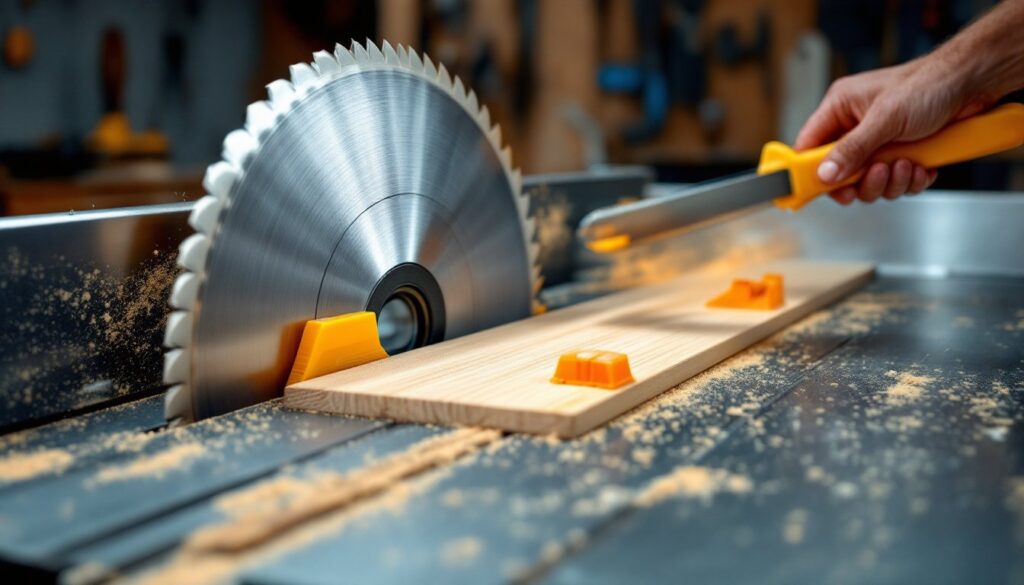
The riving knife is the single most important kickback prevention device. This curved blade positioned directly behind the saw blade keeps the kerf open, preventing the wood from pinching. Unlike older splitters, riving knives rise and fall with the blade and sit closer to the teeth, providing protection at all cutting heights. A properly installed riving knife dramatically reduces binding and should never be removed for standard through-cuts.
Anti-kickback pawls are spring-loaded metal teeth that ride on top of the workpiece. They allow wood to move forward through the blade but dig in if the piece tries to move backward. Pawls work best on rip cuts with material between ¼-inch and 1-inch thick. They’re less effective on very thin stock or angled cuts.
Blade guards shield the blade from accidental contact and typically incorporate the riving knife and pawls into one assembly. Many DIYers remove guards because they obscure the cut line or interfere with certain jigs. If the guard must come off for a specific operation, reinstall it immediately afterward and consider alternative saw methods for that cut.
Featherboards clamp to the table or fence and use flexible fingers to hold the workpiece firmly against the fence and down on the table. Position them ahead of the blade, never alongside or behind it, to avoid trapping wood. They’re especially useful when ripping thin or narrow stock.
Push sticks and push blocks keep hands at a safe distance from the blade while maintaining control. Use a push stick for narrow rips and a push block for wider panels. Quality push sticks have a notch or heel to hook behind the workpiece. Keep several within reach.
Outfeed support prevents the workpiece from tipping or binding as it exits the cut. A dedicated outfeed table, roller stand, or even a helper provides critical support for long boards or full sheets. Unsupported material can drop, rotate, or twist into the blade.
Proper Table Saw Techniques to Avoid Kickback
Even with all the safety equipment in place, technique matters. These practices reduce kickback risk and improve cut quality.
Verify fence alignment before every rip cut. Measure from the fence to the front and rear of the blade at the same tooth. The measurements should be identical or the rear slightly farther away (no more than 1/64-inch). Adjust the fence if needed.
Use the correct blade for the material. A rip blade with 24-30 teeth and aggressive hook angle works best for ripping solid lumber. A combination blade with 40-50 teeth handles both rips and crosscuts reasonably well. Crosscut and plywood blades have more teeth and different geometry. Using the wrong blade increases friction and binding.
Set blade height properly. The blade should extend approximately ¼-inch to ½-inch above the workpiece. Higher than that increases the length of blade in contact with the wood and the severity of potential kickback. Lower creates more friction and requires more force.
Feed workpieces at a steady, moderate pace. Feeding too slowly allows friction to build and can burn the wood. Feeding too fast bogs the motor and risks poor blade control. Listen to the saw, it should maintain consistent RPM throughout the cut.
Keep the workpiece flat on the table and tight to the fence. Apply downward pressure with the front hand and inward pressure (toward the fence) with the rear hand. Don’t lift or pivot the piece during the cut.
Complete every cut in one pass. Stopping mid-cut and then restarting increases the chance of misalignment. If a cut must be stopped, turn off the saw and wait for the blade to stop completely before removing the workpiece.
Support both sides of the cut for sheet goods. When ripping a full sheet of plywood, support both the piece between the blade and fence and the waste side. Let the waste fall away naturally or have a helper support it without pulling.
Never reach over or behind the blade while it’s spinning. If the offcut needs to be removed, turn off the saw and wait for the blade to stop.
Many home improvement projects featured on sites like This Old House involve precision cuts that require these fundamental safety techniques.
What to Do If Kickback Occurs
Even though all precautions, kickback can still happen. The response in those first seconds determines whether the incident ends as a close call or a serious injury.
Do not try to catch or stop the workpiece. Instinct may be to grab the flying wood, but that’s how fingers meet the blade. Let it go. The workpiece will hit the wall, floor, or whatever’s behind the operator. Property damage is fixable. Hand injuries aren’t.
Release the power switch immediately if hands are still near the saw. Most saws have accessible paddle switches designed for quick shutoff. Don’t reach across the saw or toward the blade, step back and let the blade coast to a stop.
Step to the side and away from the saw to get out of the kickback path and reassess. Take a breath. Adrenaline will be surging. Check for injuries before doing anything else.
Do not attempt to restart or clear debris until the blade has completely stopped. Even coasting blades are dangerous. Wait for zero movement.
After kickback, inspect everything. Check the workpiece for damage that might explain what happened. Inspect the blade for missing teeth or damage. Verify fence alignment and that the riving knife is properly positioned. Determine the cause before making another cut.
If the cause isn’t obvious, don’t repeat the cut the same way. Try a different approach, a different blade, alternate support, or even a different saw. Woodworkers sharing shop safety experiences frequently emphasize that figuring out why kickback occurred prevents it from happening again.
If kickback results in even minor injury, stop work. Treat wounds properly and consider whether the setup, blade, or technique needs adjustment before returning to the saw. There’s no project worth losing function in a hand.
Conclusion
Table saw kickback is preventable. Installing and using the riving knife, maintaining proper fence alignment, choosing the right blade, and following sound cutting techniques eliminate the majority of kickback risks. Recognizing warning signs and knowing how to respond if kickback does occur keeps a dangerous situation from becoming catastrophic. Respect the saw, trust the safety features, and never let familiarity breed complacency. The table saw is an indispensable tool, but only when used with the care and attention it demands.