Table of Contents
ToggleDanby refrigerators have carved out a niche in the compact cooling market, offering homeowners flexible refrigeration options beyond the traditional full-size kitchen appliance. Whether outfitting a basement bar, upgrading an apartment, or adding a second fridge to a garage workshop, understanding what Danby offers, and how to install and maintain these units, helps homeowners make informed decisions. This guide walks through model selection, installation requirements, and ongoing care to keep a Danby refrigerator running efficiently for years.
Key Takeaways
- Danby refrigerators range from 1.6 to 12 cubic feet and cost 40–60% less than full-size units, making them ideal for apartments, basements, dorms, and spaces where standard 30–36-inch refrigerators don’t fit.
- A Danby refrigerator draws only 0.5–1.5 kWh daily (15–45 kWh monthly) and requires just a standard 15-amp, 120V outlet, resulting in lower energy bills and minimal load on older electrical panels.
- Successful installation requires accurate measurements, proper leveling to prevent door gaps, 1–2 inches of clearance around the unit for condenser coil ventilation, and a 24-hour rest period after delivery before plugging in.
- Routine maintenance—cleaning condenser coils every six months, checking door gaskets, and defrosting when ice exceeds 1/4 inch—prevents compressor strain and extends your Danby refrigerator’s lifespan.
- Energy Star-certified Danby models cost $50–$100 more upfront but save 10–15% on electricity and pay back within 2–3 years compared to budget lines.
- Right-sizing your refrigerator to actual storage needs maximizes efficiency; Danby’s range of compact and apartment models lets homeowners avoid cooling unused space that oversized units would require.
Why Choose a Danby Refrigerator for Your Home?
Danby specializes in compact and apartment-sized refrigeration, targeting spaces where standard 30–36-inch refrigerators don’t fit. Their models excel in dorm rooms, home offices, workshops, rental units, and secondary entertainment areas.
Space efficiency drives most Danby purchases. A compact unit occupies as little as 1.6 cubic feet, fitting under counters or in tight closets, while apartment models max out around 10–12 cubic feet, enough for a small household without overwhelming a galley kitchen. Nominal widths range from 17 inches to 24 inches, compared to the 33–36 inches standard for full-size refrigerators.
Energy consumption remains modest. Most Danby models draw between 0.5 and 1.5 kWh per day, equivalent to 15–45 kWh monthly. For comparison, a traditional 20-cubic-foot fridge averages 50–70 kWh monthly. Lower draw translates to minimal electrical panel load, making Danby units practical for older homes with limited circuit capacity.
Affordability appeals to budget-conscious DIYers. Compact Danby refrigerators typically retail between $150 and $350, while apartment models range from $400 to $800. That’s 40–60% less than comparably featured full-size units. Installation costs stay low because most models require only a standard 15-amp, 120V outlet, no dedicated circuit or GFCI protection unless placed in a wet location per National Electrical Code (NEC) Section 210.8.
Homeowners should verify that the chosen model carries Energy Star certification if efficiency matters. Not all Danby refrigerators meet the standard, particularly older or ultra-budget lines.
Popular Danby Refrigerator Models and Their Best Uses
Compact and Mini Fridges
Danby’s compact line includes units from 1.6 to 4.4 cubic feet, ideal for beverages, snacks, and supplemental storage. The DAR017A2 series (1.7 cubic feet) fits a standard dorm room, holding roughly 48 cans plus a few condiments. It draws about 0.6 kWh daily and measures 18.7 inches wide by 20.1 inches deep by 19.9 inches tall, small enough to slide under most desks.
For home bars and entertainment spaces, the DBC026A1 beverage center (2.6 cubic feet) organizes up to 95 cans on adjustable wire shelves. Glass doors and interior LED lighting suit finished basement rec rooms. Many beverage refrigerators in this category prioritize visibility and accessibility over freezer capacity, trading the small ice-cube compartment found in dorm fridges for full-height shelving.
The DCR044A2 (4.4 cubic feet) bridges compact and apartment sizes, offering a true freezer compartment (roughly 0.5 cubic feet) capable of storing frozen meals and ice packs. It suits workshops, garage gyms, or tiny home kitchens where a full-size fridge won’t fit. Expect dimensions around 21 inches wide by 21.5 inches deep by 33 inches tall, clearances tight enough that careful measurement during space planning prevents costly returns.
Installation note: Compact models often ship with reversible door hinges. Confirm hinge orientation before purchase if cabinetry or wall placement dictates swing direction.
Full-Size and Apartment Refrigerators
Danby’s apartment line ranges from 7.3 to 12 cubic feet, meeting the needs of small households or secondary kitchens. The DFF100C1 (10 cubic feet) splits storage roughly 7 cubic feet refrigerator, 3 cubic feet freezer, matching the layout homeowners expect from traditional top-freezer models but scaled to 24 inches wide.
This width matters when retrofitting older apartments or cottages built before 1960, when cabinet openings ran narrower than today’s 30-inch standard. A 24-inch Danby slides into existing cabinetry without sawing out stiles or removing adjacent base cabinets, a DIY win that saves hours of carpentry.
The DAR110A1 (11 cubic feet) adds automatic defrost, eliminating the manual defrost cycle required by many compact freezers. Automatic defrost uses a timer and heating element to melt frost buildup, cycling every 8–12 hours. Homeowners who’ve dealt with freezer burn and ice buildup appreciate this feature, though it does increase energy consumption by roughly 10–15%.
Clearance requirements: International Residential Code (IRC) Section M1307.3 mandates minimum clearances for appliance ventilation. Danby specs typically call for 1 inch clearance on sides, 2 inches at the back, and 2 inches overhead. Blocking airflow around condenser coils forces the compressor to run longer, shortening its lifespan and hiking energy bills.
Installation Tips and Space Planning for Danby Refrigerators
Successful installation begins with accurate measurements. Measure the cabinet opening (width, depth, height), the door swing radius (add 90 degrees to the unit’s depth), and the pathway from entry door to final location. A 21-inch-wide fridge won’t navigate a 20-inch hallway turn, no matter how much wiggling.
Leveling the refrigerator prevents door-seal gaps and compressor strain. Most Danby units include adjustable front leveling legs. Use a torpedo level on the top surface, adjusting legs until the bubble centers. A slight backward tilt (1/8 to 1/4 inch over the unit’s depth) helps doors self-close, but excessive tilt stresses door hinges.
Electrical connection requires a grounded 120V outlet. NEC Section 422.16 prohibits using extension cords for fixed appliances. If the existing outlet sits behind the fridge location, install a receptacle box offset to one side so the plug remains accessible without moving the unit. Many kitchen design guides recommend outlet placement 6–12 inches to the left or right of the appliance footprint.
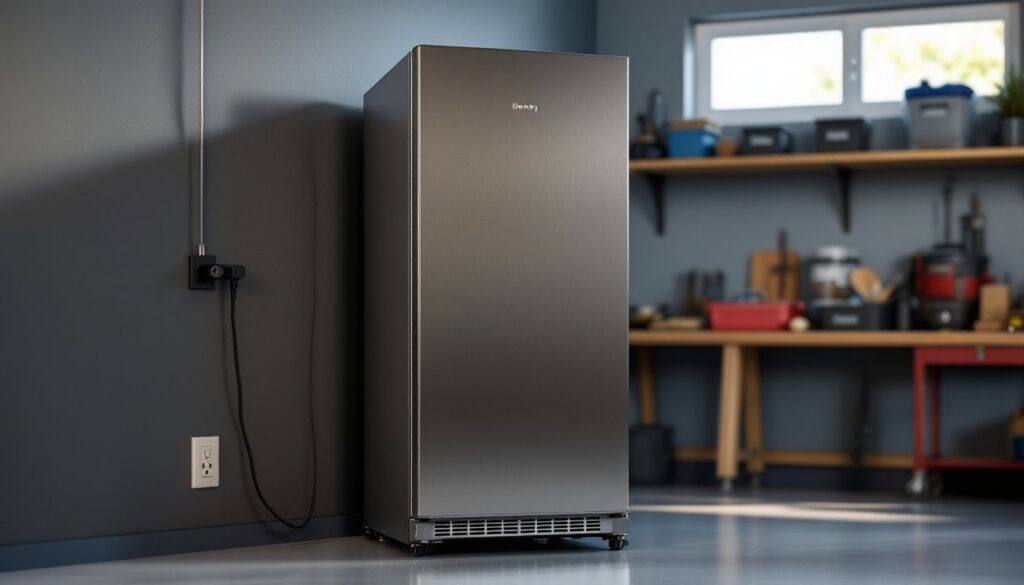
For garage or basement installations, verify the ambient temperature range. Danby refrigerators typically operate between 50°F and 90°F. Unheated garages in northern climates drop below 50°F in winter, causing compressor oil to thicken and the thermostat to malfunction. Heated workshops or insulated basement spaces avoid this issue.
Ventilation matters more than homeowners expect. Condenser coils dissipate heat: blocking airflow traps that heat, forcing the compressor to cycle more frequently. When installing in cabinetry, leave the manufacturer’s specified clearances. If building a custom enclosure, add a louvered vent at the top rear to exhaust warm air. A 4-inch by 12-inch louvre typically suffices for compact models.
Allow 24 hours before plugging in a new refrigerator. Shipping and handling can shift refrigerant and compressor oil: letting the unit rest ensures oil settles back into the compressor crankcase. Skipping this step risks compressor damage on first startup.
Safety reminder: Wear work gloves when handling refrigerators. Sharp sheet-metal edges and condenser coil fins cut skin easily. If the unit tips during maneuvering, get a helper, compact refrigerators weigh 40–80 pounds, apartment models 100–150 pounds.
Maintenance and Troubleshooting Your Danby Refrigerator
Routine maintenance extends refrigerator lifespan and maintains efficiency. Clean condenser coils every six months using a coil brush or vacuum with a crevice tool. Dust and pet hair accumulation insulates coils, reducing heat transfer and increasing compressor runtime by 20–30%. Coils typically sit on the back panel or beneath the unit behind a front grille.
Door seals (gaskets) should compress evenly when closed. Test by closing the door on a dollar bill: if it pulls out easily, the seal isn’t tight. Clean gaskets monthly with warm soapy water, grease and food residue prevent proper sealing. Replace cracked or torn gaskets immediately: aftermarket gaskets cost $30–$60 and install with a flathead screwdriver and patience.
Defrosting manual-defrost models prevents ice buildup thicker than 1/4 inch, which insulates the freezer and reduces cooling efficiency. Turn off the unit, remove contents, and let ice melt naturally (place towels underneath to catch water). Never chip ice with metal tools, puncturing the evaporator coil destroys the refrigerator. A plastic scraper or warm water in a spray bottle speeds the process safely.
Leveling check annually. Floors settle, especially in basements and older homes. A refrigerator that’s level in year one might tilt by year three. Re-check with a level and adjust legs as needed.
Common troubleshooting:
• Refrigerator won’t cool: Check that the thermostat isn’t set to the warmest setting. Verify airflow around condenser coils. If the compressor runs constantly but temps stay warm, the refrigerant may be low, a repair requiring an EPA-certified HVAC technician, not a DIY fix.
• Frost in refrigerator section: Door seal failure or prolonged door-open time lets humid air in. Check gasket integrity and minimize door openings during hot, humid weather.
• Noisy operation: Refrigerators hum and click during normal compressor cycles. Loud rattling suggests the unit isn’t level or an internal component (fan, compressor mount) has loosened. Unusual grinding or squealing warrants professional diagnosis.
• Water pooling under crisper: In auto-defrost models, a clogged defrost drain causes water to back up. Locate the drain hole (usually at the back of the fridge section, near the bottom), and flush it with warm water using a turkey baster. Inserting a pipe cleaner clears stubborn blockages.
When to call a pro: Refrigerant leaks, compressor failure, and sealed-system repairs require specialized tools and EPA certification. Attempting DIY refrigerant work violates federal law and voids warranties. If the compressor won’t start or the unit leaks oily fluid, contact a licensed appliance repair technician.
Energy Efficiency and Cost Savings with Danby
Energy efficiency directly impacts operating costs. A compact Danby drawing 0.7 kWh daily costs roughly $2.50 monthly at the national average of $0.12/kWh, or $30 annually. An apartment model at 1.2 kWh daily runs about $4.30 monthly, or $52 annually. For comparison, older full-size refrigerators can exceed $100 annually.
Energy Star certification signals 10–15% better efficiency than minimum federal standards. Danby’s Energy Star models achieve this through improved insulation (typically 2-inch polyurethane foam versus 1.5-inch in budget lines), high-efficiency compressors, and tighter door seals. The upfront premium, usually $50–$100, pays back in 2–3 years through lower electric bills.
Temperature settings affect energy use. The FDA recommends refrigerator temps at or below 40°F, freezer temps at 0°F. Setting a fridge to 35°F or a freezer to -10°F wastes energy without improving food safety. Use an appliance thermometer ($5–$10 at hardware stores) to verify actual temps rather than trusting dial markings, which often drift over time.
Location matters. Placing a refrigerator in a cool basement reduces compressor runtime compared to a hot garage or sunlit mudroom. Every 10°F increase in ambient temperature raises energy consumption by roughly 5%. Similarly, keeping the unit away from heat sources, ovens, dishwashers, direct sunlight, cuts energy draw.
Load management: A full refrigerator holds temperature better than an empty one because the stored mass acts as thermal ballast. If running a beverage fridge seasonally, consider stocking it with water jugs during off-months rather than leaving it empty, or unplug it entirely and clean it thoroughly.
Cost comparison: Homeowners comparing Danby to competitors should calculate cost per cubic foot and lifetime energy cost. A $200 Danby at 3.3 cubic feet costs $60.60/cubic foot plus $30/year to run. Over a 10-year lifespan, total cost of ownership is $500. A $350 Energy Star model at 3.5 cubic feet costs $100/cubic foot but only $25/year to run, totaling $600 over 10 years. The savings narrow when factored over the appliance’s useful life, making the decision hinge more on features (auto defrost, reversible doors, interior lighting) than pure efficiency.
Many home improvement publications emphasize that the most efficient refrigerator is one sized appropriately to actual need. Buying more capacity than required wastes energy cooling empty space. Danby’s range of sizes lets homeowners right-size their refrigeration rather than defaulting to an oversized unit.