Table of Contents
ToggleWalk into any home center, and you’ll find yourself staring at two of the most common power saws in the tool aisle, the circular saw and the miter saw. Both cut wood. Both make noise. And both will drain your weekend budget if you buy the wrong one first. But here’s the thing: they’re built for completely different jobs. A circular saw is your workhorse for breaking down sheet goods and making long rips. A miter saw excels at precise crosscuts and angled trim work. Understanding what each tool does best, and where it falls short, will save you time, money, and a lot of frustration on your next project.
Key Takeaways
- A circular saw excels at breaking down large sheet goods and making long rips, while a miter saw delivers superior accuracy for precision crosscuts and angled trim work.
- Circular saws are handheld and portable, making them ideal for jobsites where material cannot be moved, whereas miter saws are stationary tools best suited for repeatable, clean cuts in a workshop setting.
- If you can only buy one saw first, choose a circular saw for versatility on general DIY projects and basic framing—it costs less and handles ripping, crosscutting, and beveling with proper guides.
- Miter saws are essential for trim carpentry, molding installation, and furniture building because they deliver fast, consistent cuts and miters without extensive setup or measuring.
- Most experienced DIYers eventually own both tools, with many starting with a circular saw and adding a compound miter saw once projects progress from framing to finish carpentry.
What Is a Circular Saw and How Does It Work?
A circular saw is a handheld power tool with a round blade that spins at high speed to cut through lumber, plywood, and other sheet materials. The blade is mounted on an arbor beneath a spring-loaded guard, which retracts as the saw enters the material. Most circular saws use a 7-1/4-inch blade, though compact models with 6-1/2-inch blades are also common.
The saw’s baseplate (also called a shoe) rides along the surface of the material and can be adjusted to change the depth of cut or bevel angle, typically up to 45 degrees. This lets users make angled cuts or avoid cutting all the way through a workpiece.
Circular saws are corded or battery-powered. Corded models deliver consistent power for demanding cuts through dense hardwoods or stacked material. Battery-powered models (usually 18V or 20V) offer mobility and convenience, though runtime and torque depend on battery capacity.
Because the saw is handheld and the blade spins perpendicular to the motor, users guide the tool along the cut line. This makes the circular saw incredibly versatile but requires a steady hand, a straightedge guide, or a track system for precision. It’s the go-to tool when the material is too large to bring to a stationary saw.
What Is a Miter Saw and How Does It Work?
A miter saw is a stationary power tool designed to make accurate crosscuts and angled cuts in narrow stock. The blade, typically 10 or 12 inches, is mounted on a pivoting arm that swings down into the material, which rests against a fence on the saw’s base.
The saw’s miter gauge allows the blade to rotate horizontally for angled cuts, usually from 0 to 45 degrees left and right (some models extend to 60 degrees). A compound miter saw adds a bevel adjustment, tilting the blade on a second axis to make bevel cuts or compound angles, essential for crown molding and roof framing.
Some miter saws are sliding models, meaning the blade head rides on rails, extending the saw’s crosscut capacity from around 6 inches (on a basic 10-inch saw) to 12 inches or more. This makes them capable of cutting wider boards like 2x12s or full-width stair treads.
Because the material stays stationary and the blade comes down onto it, miter saws deliver repeatable, clean cuts with minimal setup. They’re built for speed and accuracy on trim, framing, and finish carpentry, not for ripping sheet goods or cutting curves.
Key Differences Between Circular Saws and Miter Saws
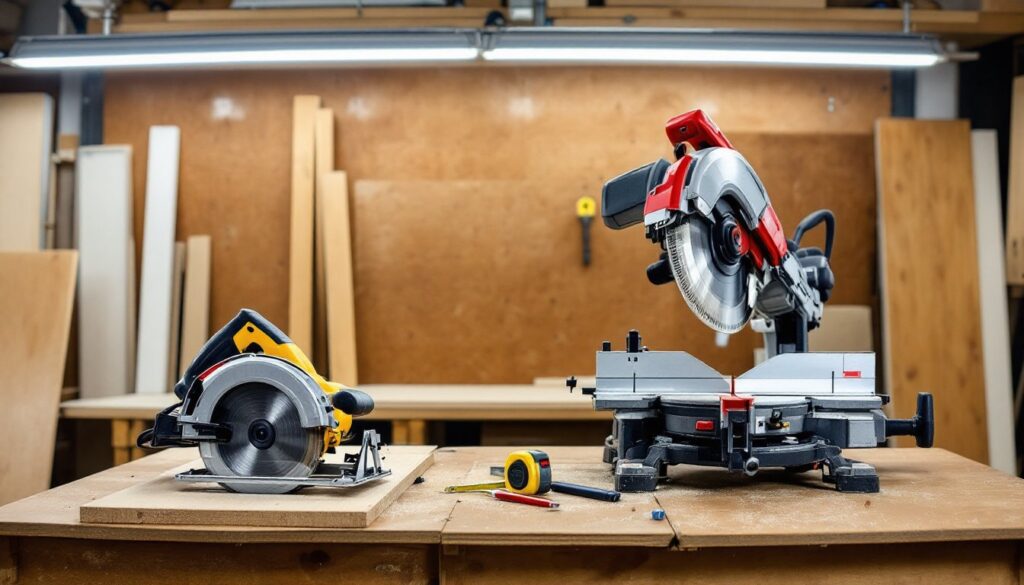
The fundamental difference is portability versus precision. A circular saw is handheld, making it portable and adaptable to jobsites where material can’t be moved. A miter saw is stationary, offering superior accuracy and repeatability for crosscuts and miters.
Cut capacity also varies significantly. Circular saws can rip a full 4×8-foot sheet of plywood or cut across long boards without repositioning. Miter saws are limited by throat width and blade diameter, most handle boards up to 12 inches wide (on sliding models), but they can’t rip lengthwise.
Blade orientation matters, too. Circular saw blades spin vertically relative to the material and cut as the tool moves forward. Miter saw blades spin horizontally and plunge downward. This gives miter saws a cleaner exit cut with less tearout, especially on finish-grade trim.
Accuracy and setup time tip heavily toward the miter saw. Built-in angle adjustments and fences make dialing in precise miters and bevels fast. Circular saws require clamps, speed squares, or guide rails for the same level of accuracy, and even then, slight operator error can throw off the cut.
Safety profiles differ as well. Miter saws keep your hands farther from the blade and include features like electric brakes. Circular saws demand more attention, kickback, binding, and loss of control are real risks without proper technique and eye and ear protection.
When to Use a Circular Saw: Best Applications
Reach for a circular saw when you need to break down large sheet goods. Cutting plywood, OSB, or MDF for subfloors, cabinet boxes, or wall sheathing is where this tool shines. With a straightedge clamped to the sheet and a sharp carbide-tipped blade, you can rip a 4×8 panel in seconds.
It’s also the tool of choice for framing and rough carpentry. Cutting 2x4s, 2x6s, and dimensional lumber to length on a jobsite is faster with a circular saw than hauling material to a stationary saw. When you’re building a deck frame or wall, the saw comes to the material, not the other way around.
Bevel cuts and plunge cuts are well within a circular saw’s range. Adjusting the baseplate angle lets you cut rafters, chamfer edges, or create angled joints. Making plunge cuts (starting a cut in the middle of a board) is simple: retract the guard, tilt the saw onto the front of the shoe, and lower the spinning blade into the material.
For demolition and remodeling work, a circular saw with a demo blade can power through old lumber, nail-embedded boards, and even thin metal. It’s less precise than finish work, but portability and aggression matter more than a clean edge.
Finally, pair a circular saw with a track saw system (a guided rail that the saw rides along), and you get near-table-saw accuracy for ripping hardwood panels or making cabinet-grade cuts on site. Some pros skip the table saw entirely and rely on a quality track system.
When to Use a Miter Saw: Best Applications
A miter saw is the right call for trim carpentry and molding installation. Cutting baseboards, crown molding, window casing, and door jambs requires tight miters and clean edges, this is where the miter saw earns its keep. Setting angles is quick, and repeating the same cut across a dozen pieces takes seconds.
It’s also essential for building furniture and frames. Whether you’re assembling picture frames, building a bookshelf, or constructing a bed frame, a miter saw delivers consistent 90-degree crosscuts and perfect 45-degree miters without tedious measuring and marking.
For deck building, a miter saw handles cutting deck boards, railings, balusters, and stair stringers to exact length. Many carpenters set up a miter saw on site with extension supports to crosscut treated lumber all day without fatigue.
Flooring installations benefit from miter saws, too. Crosscutting hardwood planks, laminate, or engineered flooring at precise lengths and angles ensures tight joints and professional results. According to experienced builders at Popular Mechanics, a miter saw drastically speeds up cutting flooring compared to hand tools.
Finally, a compound miter saw is necessary for roof framing and complex angles. Cutting rafters, hips, valleys, and jack studs involves both miter and bevel cuts. A sliding compound miter saw handles wide stock and dual angles in one pass, which would take multiple setups on a circular saw.
Which Saw Should You Buy First for Your Workshop?
If you can only afford one saw and you’re tackling general DIY projects, building a shed, installing shelving, basic repairs, buy the circular saw first. It’s more versatile, costs less (a solid corded model runs $60–$120), and handles the widest range of tasks. You’ll be able to rip, crosscut, and bevel with one tool, even if it takes a bit more setup time.
Pair a circular saw with a speed square and a clamp-on straightedge, and you can replicate many miter saw functions. It won’t be as fast or as repeatable, but it’ll get you through most beginner and intermediate projects without issue.
If your work leans heavily toward interior finish carpentry, trim installation, or furniture building, start with a 10-inch compound miter saw. You’ll appreciate the precision and speed, especially when cutting repetitive angles. Compound models (with bevel adjustment) cost $150–$300 and cover the majority of trim and framing needs. Sliding models add capacity but also cost and footprint, skip them unless you regularly cut wide boards.
For anyone doing renovation or new construction, plan to own both tools eventually. Many weekend warriors find that adding a miter saw after a year or two of projects makes sense once they’ve tackled basic framing and moved into finish work. Experienced woodworkers at Fix This Build That often recommend prioritizing based on your first three projects, if two of them involve cutting plywood or long rips, go circular. If two involve trim or angled cuts, go miter.
Avoid buying cheap versions of either saw. A wobbly miter saw or underpowered circular saw will frustrate you and produce subpar cuts. Spend a bit more upfront for a tool with solid construction, a reliable fence or shoe, and a motor that won’t bog down in hardwood.
Conclusion
Choosing between a circular saw and a miter saw isn’t about picking the “better” tool, it’s about matching the tool to the task. Circular saws handle portability, long cuts, and sheet goods. Miter saws dominate precision crosscuts, trim work, and repetitive angles. Most serious DIYers end up with both in the shop, but starting with the one that fits your first few projects will keep your tool budget in check and your cut quality high.