
Table of Contents
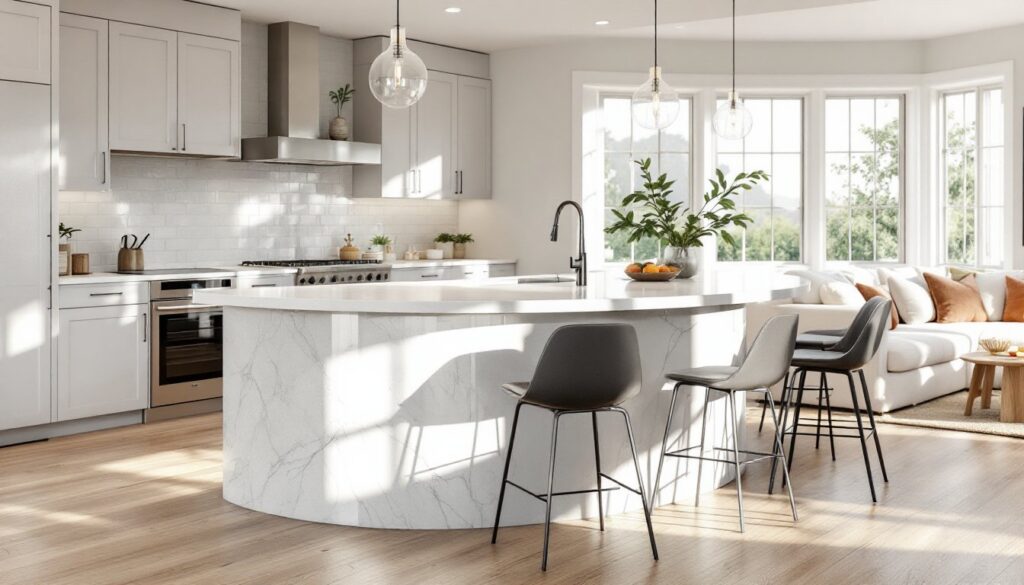
ToggleA curved kitchen island breaks up the hard angles and straight lines that dominate most kitchens. Instead of another rectangle anchoring the room, it introduces flow, softness, and a focal point that feels intentional. Whether it’s a subtle arc or a dramatic crescent, a curved island can transform both the look and the livability of the space. It’s not just a design statement, it’s a rethinking of how people move through and gather in the kitchen. This guide walks through the appeal, the practical benefits, the design styles that complement curved islands, and what to plan for before committing to the project.
Key Takeaways
- A curved kitchen island improves traffic flow by eliminating sharp corners and creating natural pathways, while offering better sight lines and safer edges for families with young children.
- Curved islands work best with solid surface materials like quartz or Corian, which handle fabrication complexity seamlessly, though they cost 15–25% more than straight countertops.
- A curved kitchen island requires at least 150 square feet of floor space with 42–48 inches of clearance on all sides, and works best in open-plan layouts where it can guide movement between zones.
- Curved island bases cost 30–50% more than straight cabinets since stock options don’t curve, necessitating custom or semi-custom cabinetry and professional installation.
- The appeal of a curved island extends beyond aesthetics—it creates more flexible seating, blurs functional zones to encourage social gathering, and feels more intentional and sculptural than rectangular designs.
- Before installing a curved island, verify appliance door swings and plumbing routes with cardboard mock-ups, and consider long-term resale value in your market since curved islands appeal more to design-forward buyers.
What Makes Curved Kitchen Islands So Appealing?
The appeal starts with geometry. Curves soften visual tension. In a room full of cabinets, corners, and appliances, a curved island creates relief. It draws the eye without competing for attention, and it invites movement rather than blocking it.
Curved islands also feel more social. A straight-edged island creates defined sides, one for prep, one for seating. A curve blurs that line. People naturally drift around it, stand closer, and engage more fluidly. It’s the difference between sitting at a bar and gathering around a fire pit.
There’s a sculptural quality, too. A well-executed curve turns cabinetry into architecture. It reads as custom, even when it’s not. That tactile, rounded edge begs to be touched and used. It signals craft and intention in a way that stock island layouts rarely do.
Finally, curved islands work in both minimalist and traditional kitchens. They don’t belong to one aesthetic. The form itself is neutral enough to adapt, modern with waterfall quartz, classic with beadboard and butcher block.
Design Styles That Work Best with Curved Islands
Contemporary and modern kitchens embrace curved islands as sculptural elements. Think seamless materials, solid surface countertops, integrated sinks, and hidden fasteners. The curve becomes the hero. Pair with flat-panel cabinetry, handleless doors, and monochrome palettes. Waterfall edges that follow the curve amplify the effect.
Transitional kitchens benefit from the curve’s ability to soften traditional elements without abandoning them. A curved island with shaker-style doors, a contrasting paint color, and a natural stone top bridges old and new. It keeps the warmth of classic design while adding contemporary flow.
Mediterranean and European-inspired kitchens lean into curves naturally. Plaster-finished islands, terracotta tile, and arched doorways all work in harmony with a curved centerpiece. Materials like honed marble, limestone, or reclaimed wood reinforce the organic, lived-in aesthetic.
Open-plan layouts gain the most from curved islands. When the kitchen flows into the living or dining area, a curve guides traffic and defines zones without walling them off. It’s a spatial tool disguised as a design choice. Many kitchen remodeling inspiration platforms showcase curved islands in open-concept homes for this reason.
Practical Benefits: Beyond Aesthetics
Improved traffic flow is the biggest functional win. A curved island eliminates sharp corners that people clip with hips or grocery bags. It creates a natural path around the workspace, especially in kitchens with multiple entry points. The radius of the curve acts like a traffic roundabout, guiding movement without funneling it.
More usable seating comes from the geometry. A curved overhang can accommodate more stools than a straight edge of the same length. The convex side offers flexibility in seating arrangement, and it feels less regimented. Kids don’t fight over the “good seat.”
Safer for families with young children. No protruding corners at head or hip height. The rounded edge reduces the risk of injury during the chaos of meal prep or morning routines. It’s a passive safety feature that doesn’t compromise style.
Better sight lines around the kitchen. A curve doesn’t block views the way a boxy island does. Someone at the cooktop can see someone at the sink. Parents can supervise kids in the adjacent room. It opens up the space visually, even when the footprint stays the same.
Curved islands also handle integrated appliances more gracefully. A dishwasher or wine fridge tucked into the curve doesn’t interrupt the line. The form absorbs the function. Straight islands often look chopped up when appliances break the run.
Key Considerations Before Installing a Curved Island
Space and Layout Requirements
A curved island demands more floor area than a straight one of similar counter space. The arc eats into the room. As a rule, maintain 42 to 48 inches of clearance on all sides for comfortable traffic flow. Tighter spaces can work, but only if the curve is subtle and the kitchen has a single primary work zone.
Measure the swing radius of appliances and cabinet doors. A curve that looks great on paper can block a dishwasher door or refrigerator swing. Mock it up with cardboard or painter’s tape on the floor before committing.
Consider the work triangle, the relationship between sink, stove, and refrigerator. A curved island can enhance or disrupt it. If the island houses the sink or cooktop, the curve should guide movement between zones, not force awkward angles. Most designers recommend keeping each leg of the triangle between 4 and 9 feet.
Curved islands work best in kitchens with at least 150 square feet of floor space. Smaller kitchens benefit more from streamlined, space-efficient layouts. If the room feels cramped with a curved island in the plan, it’ll feel worse once it’s built.
Material and Countertop Choices for Curved Designs
Solid surface materials like quartz, Corian, or Dekton handle curves best. They’re fabricated to shape, seamed invisibly, and don’t require edge banding. Expect to pay 15 to 25% more for fabrication compared to straight runs due to templating complexity and waste.
Natural stone, granite, marble, quartzite, can be curved, but it’s harder and costlier. Slabs are cut and polished to follow the radius. Seams may be more visible depending on the curve’s tightness. Work with a fabricator experienced in curved stone. Not all shops have the equipment or skill.
Butcher block and wood can be laminated and shaped into curves, but they’re prone to movement with humidity. Use kiln-dried hardwood and seal all surfaces, top, bottom, and edges. Expect some seasonal expansion and contraction. Wood curves look stunning but require more maintenance.
Tile works for gentle curves but struggles with tight radii. Small-format tiles (like 2×2-inch mosaics) conform better than large slabs. Grout lines will be uneven, that’s unavoidable. Tile is budget-friendly but labor-intensive on curves.
Laminate and edge banding can handle mild curves with heat forming, but sharp bends will crack or peel. Not recommended for dramatic arcs. If budget is tight and the curve is subtle, post-form laminate might work, but it’ll look budget.
For the cabinet base, custom or semi-custom cabinetry is required. Stock cabinets don’t curve. Expect curved bases to cost 30 to 50% more than equivalent straight runs. Frameless (European-style) cabinets adapt to curves more easily than face-frame construction.
Toe kicks and baseboards around curved islands need to be scribed or flexible. Rubber or vinyl base molding bends: wood does not. Some installers use thin plywood strips soaked and clamped to shape. Budget extra time for trim details.
Don’t overlook electrical and plumbing runs. Curved islands with sinks or cooktops need mechanical rough-ins planned early. Curved cabinetry leaves less room for error in pipe and conduit routing. Hire a plumber and electrician familiar with non-standard layouts. Depending on scope, permits may be required, check local building codes before rough-in.
Seating overhangs on curves need support. Standard countertop brackets won’t work. Floating or cantilevered overhangs require structural blocking inside the cabinet or steel reinforcement. For overhangs beyond 10 inches, consult a structural engineer or experienced fabricator. Many design sourcebooks illustrate how professional installers handle cantilevers on curved islands.
Finally, think about resale. Curved islands are polarizing. Some buyers see them as a premium feature: others see a remodel project. If the home is in a conservative market or the kitchen is already highly customized, a curved island might narrow the buyer pool. In design-forward markets or high-end homes, it’s usually a plus. Consider how long you plan to stay and whether the investment pays off in daily use or future value. For broad appeal and current kitchen trends, balance boldness with timelessness.
Conclusion
A curved kitchen island isn’t just a countertop, it’s a spatial decision that affects flow, function, and feel. It requires more planning, costs more to build, and demands skilled fabrication. But for the right kitchen and the right homeowner, it delivers a level of distinction and usability that straight edges can’t match. Measure carefully, budget realistically, and work with experienced pros.